



Introduction
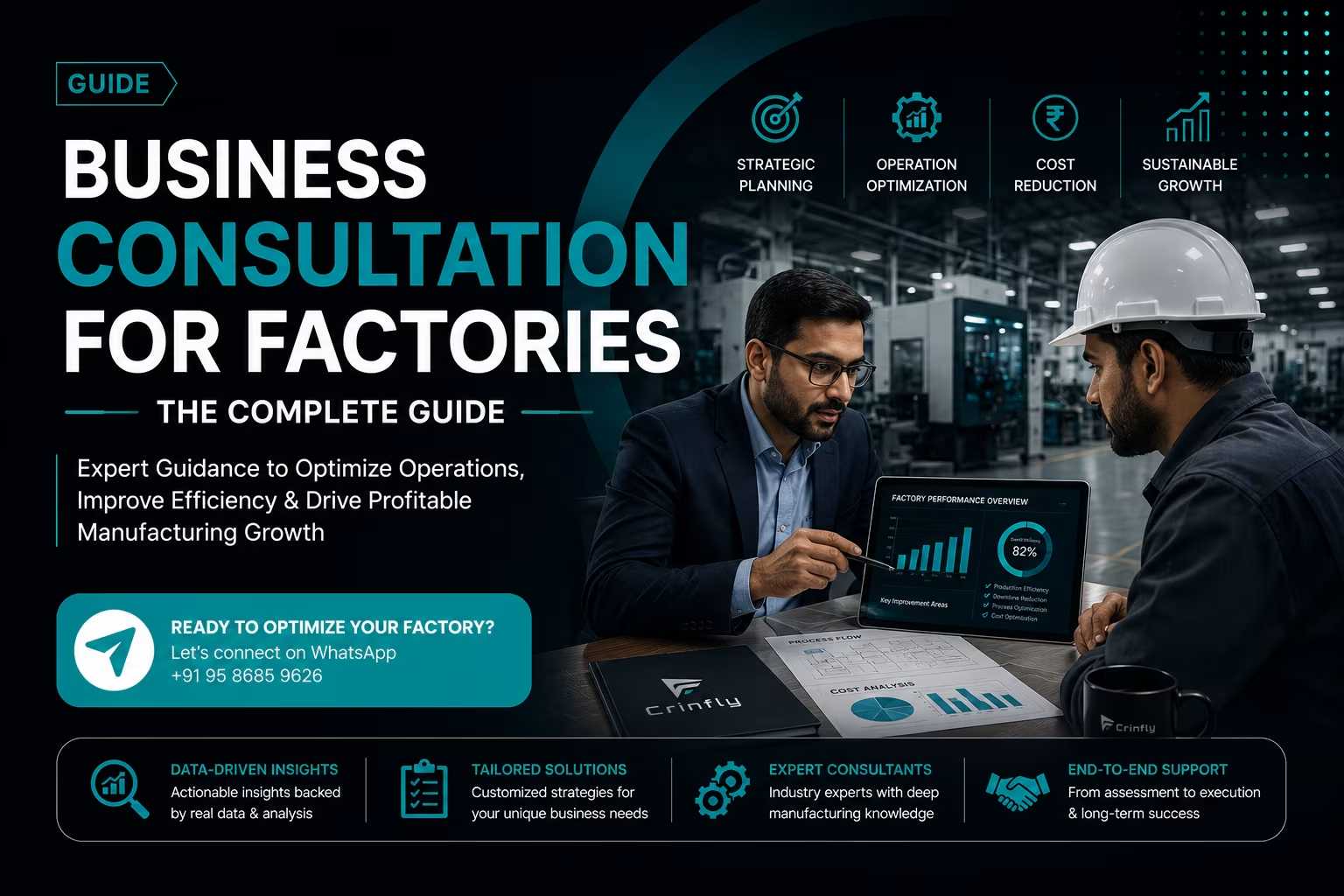
For modern factory owners, scaling a manufacturing business has never been more complex. The challenge is no longer just about acquiring raw materials and keeping machines running; it is about synchronizing disparate departments, surviving supply chain volatility, and adopting intelligent technologies without halting daily production. Traditional generic advice falls flat on the factory floor because it ignores the heavy realities of industrial overhead and machinery limitations. By engaging in specialized business consultation and integrating into the Crinfly Ecosystem, manufacturers can stop treating their facilities as a collection of isolated assets. Instead, they can fuse engineering, operations, and market strategy into a unified, highly profitable company brain designed for aggressive business growth.
Buyer Intent Block
Definition
Industrial business consultation is a specialized advisory process where experts analyze a manufacturing company's entire operational lifecycle—from supply chain and machinery utilization to digital market positioning—to design actionable strategies for scaling profitability.
Quick Answer
To maximize factory output and profit margins, business consultation identifies hidden production bottlenecks, eliminates data silos between departments, and strategically aligns capital expenditure with long-term technological upgrades.
Expert Tip
Never hire a consultant who only looks at your financial spreadsheets. True operational transformation requires a consultant who will physically walk your factory floor and audit your heavy machinery.
Decision Rule
If your factory is experiencing a gross profit margin decline despite an increase in top-line revenue, you must immediately initiate a comprehensive operational audit to locate internal inefficiencies.
Warning
Implementing advanced software solutions without first consulting on the physical layout and capabilities of your legacy machinery will inevitably result in catastrophic data misalignment and wasted capital.
Best Practice
Always ensure that any operational efficiency gained on the factory floor is immediately communicated to your industrial marketing team so they can leverage your increased capacity to win larger B2B contracts.
Table of Contents
- Why Factory Owners Need Specialized Consultation
- The F.O.R.G.E. Consulting Framework
- Comparison: Industrial vs. Generic Consultation
- Step-by-Step Guide to the Consultation Process
- Current Trends in Manufacturing Strategy
- 5 Common Mistakes When Hiring a Consultant
- Key Facts at a Glance
- Frequently Asked Questions
Why Factory Owners Need Specialized Consultation
Quick Answer
Factory owners require specialized industrial consultants because manufacturing challenges involve physical constraints, heavy capital expenditures, and complex supply chains that generic business advisors do not understand.
Why It Matters
Making a strategic error in a software company might cost a few weeks of developer time. Making a strategic error in a manufacturing plant—such as buying the wrong automated packaging line—can cost millions of dollars and cause months of irreversible downtime.
Expert Insight
As a senior consultant, I frequently encounter factory owners who are exhausted from acting as the single point of failure for their business. Specialized consultation removes the owner from daily fire-fighting and builds a resilient, systemized ecosystem that operates autonomously.
Detailed Explanation
The industrial sector operates on razor-thin margins where every second of machine downtime directly burns cash. A specialized business consultation dives deeply into Overall Equipment Effectiveness (OEE), labor allocation, and material waste. It bridges the critical gap between what the engineering department designs and what the factory floor can actually produce at scale, ensuring that future investments in automation yield a guaranteed positive ROI.
Real Example
A regional packaging facility was struggling to meet order deadlines despite running three shifts. A generic consultant suggested hiring more staff. Our specialized industrial consultation revealed that the actual bottleneck was an outdated end-of-line packaging machine operating at a 15% slower cycle rate than the upstream fillers. By upgrading one specific machine, the facility eliminated the need for a third shift entirely.
Business Application
Use consultation to objectively audit your facility before seeking outside investment or attempting to sell the business. A deeply optimized, systemized factory commands a significantly higher valuation in the industrial marketplace.
Key Takeaway
Industrial business consultation is not an expense; it is a risk-mitigation strategy that protects your capital equipment investments and accelerates your path to Industry 5.0.
The F.O.R.G.E. Consulting Framework
To systematically scale manufacturing operations, the Crinfly Ecosystem utilizes the proprietary F.O.R.G.E. framework. This methodology ensures no operational blind spots remain hidden from ownership.
- Foundational Audit: We begin by mapping your current reality. This includes evaluating legacy machinery capabilities, workforce skill levels, and existing digital infrastructure to establish a baseline.
- Operational Mapping: We trace the exact flow of data and materials through your facility. We identify where engineering schematics get delayed before reaching the CNC machines, or where manual data entry causes supply chain friction.
- Resource Optimization: We restructure your capital and labor allocation. This often means shifting human workers away from dangerous, repetitive tasks and utilizing targeted smart robotics to handle heavy lifting.
- Growth Strategy: Once the floor is optimized, we build a scaling roadmap. We determine exactly what machinery upgrades will be required to handle a 50% or 100% increase in production volume over the next three years.
- Ecosystem Integration: Finally, we connect the newly optimized production floor to your industrial branding and marketing efforts, transforming operational efficiency into a competitive sales advantage.
Comparison: Industrial Consultant vs. Generic Management Consultant
| Decision Factor | Specialized Industrial Consultant (Crinfly) | Generic Management Consultant |
|---|---|---|
| Cost | Moderate to High; tied directly to operational ROI | High; often billed by hourly corporate rates |
| ROI | Immediate impact on machine uptime and waste reduction | Delayed; focused primarily on theoretical financial models |
| Maintenance | Builds autonomous, self-sustaining factory ecosystems | Requires constant re-engagement for new strategies |
| Scalability | Prepares the physical plant for automated scaling | Focuses mostly on scaling headcount and HR policies |
| Automation Readiness | Deep expertise in PLCs, CNCs, and Robotics integration | Zero expertise in physical manufacturing hardware |
| Complexity | Handles heavy machinery, supply chain, and digital alignment | Handles organizational charts and software subscriptions |
| Risk | Low; strategies are grounded in physical production realities | High; recommendations may ignore factory floor constraints |
| Best Use Case | Factories, CNC shops, packaging plants, heavy industry | Corporate offices, retail chains, software startups |
| Limitations | Requires deep access to proprietary factory data | Lacks the ability to evaluate capital equipment purchases |
Step-by-Step Guide to the Consultation Process
- The Discovery Phase: The consultant conducts extensive interviews with the facility owner, chief engineer, and floor managers to understand the macro-level goals and micro-level frustrations.
- The Factory Floor Walkthrough: Experts physically audit the manufacturing environment, observing machine cycle times, safety protocols, and the physical flow of raw materials to finished goods.
- Data and Financial Analysis: The consulting team reviews historical production data, utility costs, scrap rates, and CRM pipelines to identify financial leaks.
- Gap Identification: We highlight the discrepancies between the current operational output and the theoretical maximum capacity of the facility.
- Strategic Roadmap Development: A customized action plan is created, utilizing the F.O.R.G.E. framework to outline required machinery upgrades, software integrations, and process changes.
- Phased Implementation: Instead of disrupting the entire plant, changes are rolled out in calculated phases to ensure daily revenue-generating production never completely stops.
- Ecosystem Synchronization: The final step connects the improved manufacturing metrics directly to the sales and marketing teams, allowing them to confidently sell the new, higher-capacity output.
Current Trends in Manufacturing Strategy
Quick Answer
Modern manufacturing strategy is heavily leaning into predictive AI maintenance, localized supply chains, and the merging of IT (Information Technology) with OT (Operational Technology).
Why It Matters
Factory owners who ignore these trends will find themselves unable to compete on price or delivery speed against competitors who have digitized their factory floors.
Expert Insight
The most successful manufacturing leaders are no longer guessing when a machine will fail. They are using consulting engagements to install predictive sensors that tell them exactly when a motor bearing will burn out, allowing them to fix it during a scheduled weekend shift rather than suffering a catastrophic failure on a Tuesday afternoon.
Detailed Explanation
The convergence of IT and OT means that the front office software finally talks directly to the factory floor hardware. Business consultation today focuses heavily on breaking down these historical silos. Furthermore, due to global instability, consultants are actively helping factories redesign their supply chains to source critical components locally, intentionally trading slightly higher raw material costs for guaranteed availability and resilience.
Real Example
An automotive parts supplier utilized business consultation to integrate their ERP system directly with their CNC machining centers. When raw aluminum stock dipped below a 14-day supply, the system automatically generated a purchase order to their local vendor, entirely removing human error from the procurement cycle.
Business Application
Evaluate your current data infrastructure. If your floor managers are still using clipboards and whiteboards to track daily output, your first consulting priority must be digital integration.
Key Takeaway
Survival in the modern industrial landscape requires treating data as a critical raw material, just as important as steel or plastic.
5 Common Mistakes When Hiring a Consultant
- Mistake 1: Hiding the Real Problems. Why it happens: Owners feel embarrassed by inefficient legacy processes. Impact: The consultant solves the wrong problems, wasting time and money. How to avoid it: Provide total, unvarnished transparency regarding your financials and floor operations from day one.
- Mistake 2: Expecting Immediate Magic. Why it happens: Desperation for a quick turnaround in a struggling plant. Impact: Frustration when systemic physical changes take months to yield results. How to avoid it: Establish realistic, data-driven timelines for ROI during the discovery phase.
- Mistake 3: Failing to Involve Floor Workers. Why it happens: Treating consultation strictly as an executive boardroom exercise. Impact: Machine operators reject the new protocols because they were not consulted on the practical realities. How to avoid it: Mandate that the consultant interviews the people actually running the machines.
- Mistake 4: Ignoring the Implementation Phase. Why it happens: Paying for a strategic report but refusing to pay for execution support. Impact: The strategy sits in a binder on a desk while the factory continues to operate inefficiently. How to avoid it: Always contract for both strategy and guided implementation.
- Mistake 5: Hiring Non-Industrial Advisors. Why it happens: Using a friend's recommendation for a generic business coach. Impact: Receiving advice that is completely disconnected from the realities of heavy manufacturing. How to avoid it: Only partner with consultants who have proven experience on industrial factory floors.
Key Facts at a Glance
- Definition: Business consultation for factories is the strategic realignment of machinery, personnel, and data to maximize industrial profitability.
- Best Practices: Always audit physical machinery constraints before purchasing advanced operational software.
- Decision Criteria: Engage a consultant when your revenue is growing but your profit margins are shrinking due to operational chaos.
- Checklist: Map the factory floor, audit energy and waste metrics, interview floor staff, align IT with OT, and build a phased scaling roadmap.
- Summary: Specialized consultation transforms a reactive, chaotic manufacturing plant into a proactive, highly optimized ecosystem primed for sustainable market dominance.
Frequently Asked Questions
How long does a typical industrial business consultation take?
The timeline varies based on the size of the facility, but a standard foundational audit typically takes 3 to 4 weeks. Following the audit, the implementation of the strategic roadmap is often broken down into 90-day sprints. This phased approach ensures that critical changes to your manufacturing processes can be executed safely without causing massive disruptions to your current production schedules.
Will a consultant disrupt my daily production operations?
No, a professional industrial consultant is trained to observe and analyze without halting your revenue-generating activities. During the discovery phase, they will shadow your operators and monitor machine cycles in real-time. When it comes time for implementation, any necessary machinery downtime or software integration is strictly scheduled during planned maintenance windows, off-shifts, or weekends.
Do I need business consultation if my factory is already profitable?
Yes, profitability is often an illusion masking massive missed potential. Many factories are profitable simply because they have strong client demand, but they are leaving hundreds of thousands of dollars on the table due to high scrap rates, unoptimized labor, and excessive machine idle times. Consultation helps you capture that lost revenue and prepares your infrastructure to scale aggressively without breaking.
How does business consultation integrate with our engineering department?
A critical focus of our consultation is eliminating the friction between engineering and the factory floor. Often, engineers design products that look perfect in CAD but are highly inefficient to physically manufacture. We implement feedback loops ensuring your engineering team designs specifically for manufacturability (DFM), which drastically reduces cycle times, material waste, and tooling costs on the floor.
Can a consultant help us decide which machinery to buy?
Absolutely. One of the highest-value deliverables of an industrial consultant is objective capital expenditure (CapEx) planning. Instead of relying on a biased sales pitch from a machinery vendor, a consultant analyzes your exact production data to recommend the right CNC machines, robotics, or packaging lines that integrate seamlessly into your current ecosystem and guarantee a measurable ROI.
How do we measure the ROI of a business consultation engagement?
We establish rigid Key Performance Indicators (KPIs) before the engagement begins. Common industrial metrics include a percentage increase in Overall Equipment Effectiveness (OEE), a reduction in material scrap rates, a decrease in unplanned machine downtime, and an acceleration in order fulfillment times. The financial value of these improvements typically covers the cost of the consultation within the first six months.
What if my current staff is resistant to the changes suggested by the consultant?
Change management is a core component of the F.O.R.G.E. framework. Resistance usually stems from a fear of automation replacing jobs or a lack of understanding. We mitigate this by involving key floor operators in the problem-solving process early on. We demonstrate how the new systems will remove the dangerous, dirty, and dull aspects of their jobs, elevating them to higher-value roles managing the new technologies.
Can a consultant help us fix severe supply chain bottlenecks?
Yes. Supply chain resilience is vital for factory survival. A consultant will audit your procurement strategies, identify single-source vulnerabilities, and help you diversify your vendor base. We also implement digital inventory tracking systems that tie directly into your production forecasting, ensuring you never face a line-stoppage due to a missing fifty-cent component.
Why do you recommend aligning factory operations with marketing?
If you increase your production capacity by 30% through operational consulting, but your sales team does not know how to sell that extra capacity, you have wasted your money. By integrating your floor data with your industrial marketing, you can immediately begin targeting larger B2B clients, using your newly optimized, highly reliable production capabilities as your primary competitive differentiator.
Will a consultant force us to adopt expensive AI and Industry 5.0 tech immediately?
No. Throwing advanced technology at a broken process simply creates a faster broken process. A reputable consultant focuses on getting the fundamentals right first—optimizing the physical layout, standardizing workflows, and training staff. Only when the foundation is solid do we introduce targeted automation and AI solutions, ensuring that every technological investment has a clear, justifiable business case.
What is the difference between IT (Information Technology) and OT (Operational Technology)?
IT encompasses your front-office systems: email, accounting software, and CRM. OT encompasses the hardware and software that directly monitors and controls physical devices on the factory floor, such as PLCs (Programmable Logic Controllers) and SCADA systems. A major goal of modern industrial consultation is bridging the gap between IT and OT, so your financial data accurately reflects real-time machine performance.
Do you evaluate our facility's energy consumption and sustainability?
Yes. Energy costs are one of the highest variable overheads for a manufacturing plant. During the foundational audit, we look for simple, immediate wins—like fixing compressed air leaks, which can waste massive amounts of electricity. We also evaluate the efficiency of your heavy motors and heating systems, outlining a strategy to reduce your carbon footprint while simultaneously lowering your monthly utility bills.
What is the first step I should take to start the consultation process?
The first step is to request an introductory ecosystem audit. You do not need to prepare complex presentations; simply gather your previous quarter's financial statements, a list of your primary machinery, and a basic outline of your current organizational chart. The consultant will use this data to identify immediate red flags and outline the scope of a comprehensive strategic engagement.
Conclusion
Running a successful manufacturing plant requires far more than just keeping the machines turning; it requires a hyper-optimized, seamlessly integrated operational strategy. Attempting to scale a factory using fragmented advice or trial-and-error inevitably leads to burned capital and exhausted management. By embracing a specialized industrial business consultation, factory owners gain absolute clarity over their operations. Through the F.O.R.G.E. framework, you align your engineering, physical automation, and digital marketing into a single, powerful ecosystem—ensuring that your business is not just surviving the modern industrial landscape, but dominating it.
Call to Action
Stop letting hidden inefficiencies drain your factory's profit margins. Partner with the Crinfly Ecosystem today to secure a comprehensive operational audit. Let our senior consultants bridge the gap between your factory floor and your business growth strategies.


