



Introduction
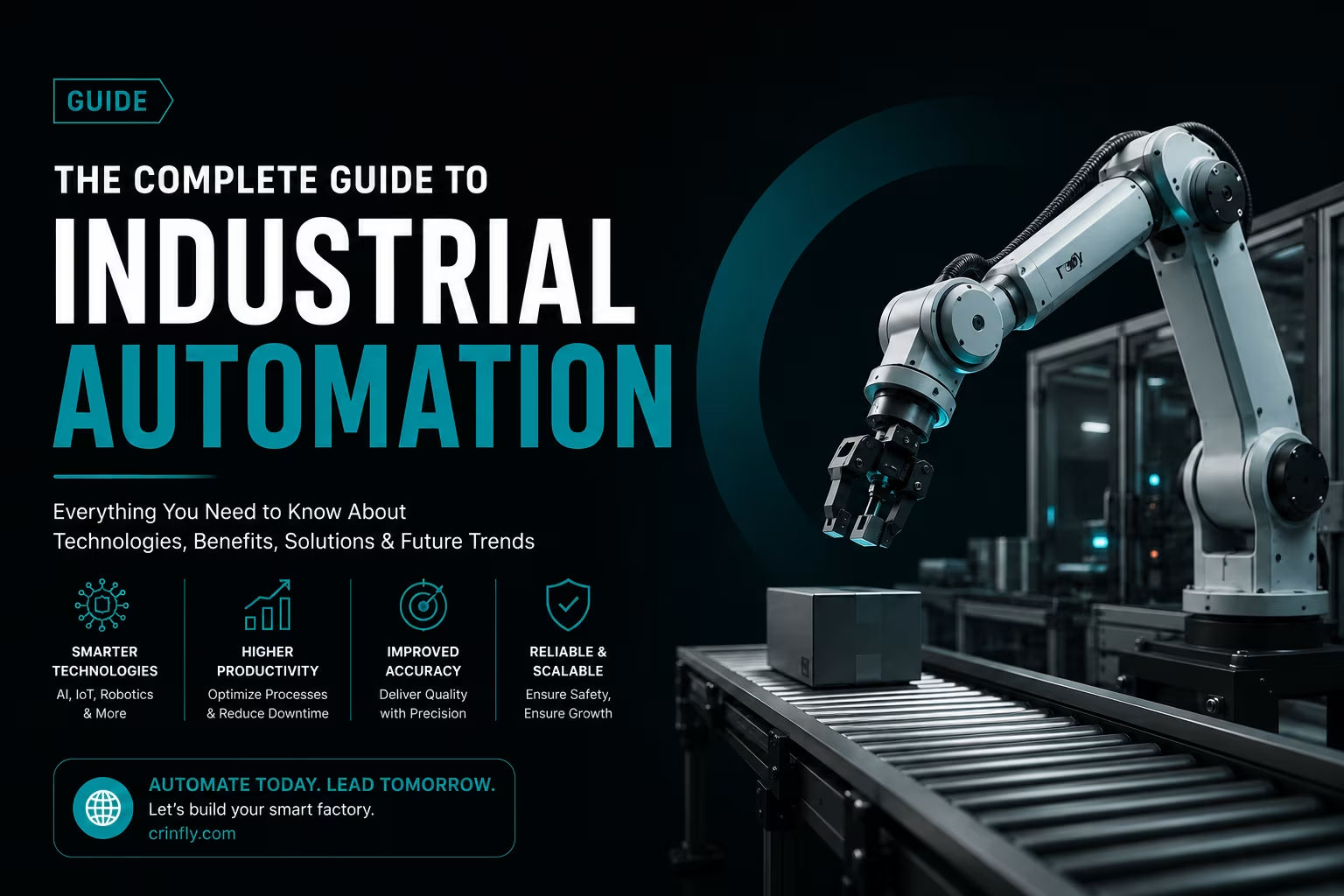
The days of viewing industrial automation as a luxury upgrade are over. In the modern manufacturing landscape, automation is the baseline for survival. Faced with crippling labor shortages, volatile supply chains, and demanding production quotas, manufacturers can no longer rely purely on manual assembly and fragmented legacy machinery. By plugging your facility into the Crinfly Ecosystem, you transform isolated machines into a synchronized company brain. Our comprehensive approach to automation perfectly aligns with your engineering capabilities and packaging demands, ensuring that a speed increase on the factory floor translates directly into sustainable business growth.
Buyer Intent Block
Definition
Industrial automation is the use of control systems, such as PLCs, robotics, and advanced software, to handle different processes and machinery in manufacturing with minimal human intervention.
Quick Answer
To successfully automate a manufacturing facility, you must first standardize your current manual processes, integrate smart sensors into your legacy equipment, and deploy robotics strictly to eliminate your highest-cost bottlenecks.
Expert Tip
Never automate a broken process. If your manual workflow is inefficient, automating it will only make it produce bad parts faster. Standardize the workflow first.
Decision Rule
If your Overall Equipment Effectiveness (OEE) is below 60% and manual labor costs account for more than 40% of your operational budget, immediate investment in robotic automation is required.
Warning
Purchasing automated machinery that uses closed, proprietary software will create isolated data silos, preventing your factory from ever achieving true Industry 5.0 synchronization.
Best Practice
Always align your physical automation upgrades with your industrial marketing strategy, allowing your sales team to leverage your new capacity and precision to win premium B2B contracts.
Table of Contents
- Shifting from Manual to Smart Automation
- The S.Y.N.C. Automation Framework
- Comparison: Legacy Automation vs. Smart Robotics
- Step-by-Step Automation Integration Guide
- Current Trends in Factory Automation
- 5 Common Automation Mistakes
- Key Facts at a Glance
- Frequently Asked Questions
Shifting from Manual to Smart Automation
Quick Answer
Smart automation moves beyond the rigid, repetitive programming of the past, utilizing AI and connected sensors to allow machines to self-adjust to real-time production variables.
Why It Matters
Relying on manual labor for highly repetitive tasks exposes your business to high turnover rates, inconsistent product quality, and dangerous safety liabilities that erode profit margins.
Expert Insight
As a senior automation expert, I see facilities buy million-dollar robots, only to run them at 30% capacity because they failed to automate the conveyors feeding raw material to the robot. True automation is holistic.
Detailed Explanation
Traditional manufacturing relied on humans to physically move parts, inspect quality, and pack boxes. Smart automation shifts the human role from physical laborer to ecosystem manager. By integrating Programmable Logic Controllers (PLCs) with Supervisory Control and Data Acquisition (SCADA) systems, a factory can monitor its exact output, energy usage, and machine health down to the millisecond, allowing for predictive rather than reactive maintenance.
Real Example
A regional bottling plant replaced their manual end-of-line palletizing crew with a 6-axis industrial robot arm. Not only did this eliminate lifting injuries, but it increased palletizing speed by 45%, entirely clearing a massive bottleneck that was choking their upstream fillers.
Business Application
Promote your newly automated, highly consistent production capabilities in your industrial branding. Buyers pay a premium for guaranteed consistency and zero defect rates.
Key Takeaway
The goal of automation is not to eliminate your workforce, but to elevate them. Machines do the heavy lifting; humans handle the strategy.
The S.Y.N.C. Automation Framework
To prevent costly integration failures, the Crinfly Ecosystem developed the proprietary S.Y.N.C. framework for deploying industrial automation.
- Systematize: Document and optimize every manual step of your current production line before writing a single line of automation code.
- Yield-Focus: Identify the specific bottleneck costing you the most money (e.g., end-of-line packaging) and apply automation capital there first.
- Network: Ensure every new automated machine connects to a central SCADA or ERP system using open protocols like OPC UA, preventing data silos.
- Control: Implement AI-driven predictive maintenance and train your human workforce to monitor dashboards and control the newly automated ecosystem.
Comparison: Legacy Automation vs. Smart Robotics
| Feature | Legacy Automation (Hard Automation) | Smart Robotics (Industry 5.0) |
|---|---|---|
| Cost Structure | High initial CapEx, expensive to retool | High CapEx, but extremely cheap to reprogram |
| Flexibility | Very low; built for a single specific product | Very high; easily adapted for new product lines |
| Maintenance | Reactive; break-fix model | Predictive; AI sensors detect wear before failure |
| Scalability | Difficult; requires physical line teardown | Modular; easily scales via software updates |
| Data Integration | Isolated; manual data extraction required | Seamless; feeds real-time data to the company brain |
| Complexity | High mechanical complexity | High software complexity, streamlined mechanics |
| Risk | Total obsolescence if product design changes | Low; asset retains value across multiple product lifecycles |
| Best Use Case | Mass production of identical, unchanging items | High-mix, variable volume agile manufacturing |
| Limitations | Cannot adapt to variations in raw materials | Requires upskilling of the current workforce |
Step-by-Step Automation Integration Guide
- Conduct an OEE Audit: Measure the Overall Equipment Effectiveness of your current manual lines to establish a baseline for your automation ROI.
- Identify the Primary Bottleneck: Do not automate the fastest part of your line. Automate the specific point where materials pile up and cause delays.
- Standardize the Process: Remove all human variations from the task. A robot requires absolute consistency in how a part is presented to it.
- Select the Right Hardware: Work with an industrial consultant to choose between fixed automation, collaborative robots (cobots), or heavy-payload 6-axis arms based on your specific needs.
- Enforce Open Networking Protocols: Demand that all machinery vendors supply equipment capable of communicating on standard industrial IoT networks.
- Phased Deployment: Install the automation over a weekend or planned maintenance window to avoid disrupting daily revenue generation.
- Train the Operators: Transition your manual laborers into robotic cell operators, training them on safety protocols, basic troubleshooting, and HMI (Human-Machine Interface) navigation.
Current Trends in Factory Automation
Quick Answer
Factories are rapidly adopting collaborative robots (cobots), AI-driven machine vision for quality control, and digital twin technology for risk-free simulation.
Why It Matters
These technologies drastically lower the barrier to entry for automation. Small and medium enterprises (SMEs) can now afford robotic integration that was previously reserved for massive automotive plants.
Expert Insight
The most lucrative trend is the use of AI machine vision. Instead of a human staring at a conveyor belt looking for scratches, a smart camera can inspect 1,000 parts a minute with 100% accuracy, immediately ejecting defective units.
Detailed Explanation
Digital Twin technology allows engineers to build a completely virtual, 3D replica of your factory floor. Before you spend a dollar moving physical machinery, you can simulate how an automated robot will impact traffic flow and cycle times in the virtual world. Cobots are also changing the floor dynamic; because they have built-in force sensors, they can work safely alongside humans without requiring expensive, space-consuming safety cages.
Real Example
A custom metal fabrication shop used a digital twin to simulate adding an automated welding cell. The simulation revealed that their forklift path would be blocked, saving them $30,000 in physical re-routing costs before installation even began.
Business Application
Leverage the massive reduction in scrap rates provided by automated quality control to offer industry-leading warranties, dominating your B2B competitors.
Key Takeaway
Automation is no longer rigid and dangerous. Modern smart automation is flexible, safe, and highly collaborative with your human workforce.
5 Common Automation Mistakes
- Mistake 1: Automating a Bad Process. Why it happens: Belief that robots solve fundamental workflow flaws. Impact: The robot creates defective parts at lightning speed. How to avoid it: Perfect the process manually first.
- Mistake 2: Ignoring End-of-Line Packaging. Why it happens: Tunnel vision on the core manufacturing step. Impact: The new high-speed CNC machine produces parts so fast that the manual packing team cannot keep up, causing floor chaos. How to avoid it: Automate packaging lines concurrently.
- Mistake 3: Buying Closed Proprietary Systems. Why it happens: Relying on a single vendor's ecosystem. Impact: You are locked out of your own data and cannot integrate third-party sensors in the future. How to avoid it: Demand standard protocols like MQTT or OPC UA.
- Mistake 4: Excluding Floor Staff from Planning. Why it happens: Executives plan automation entirely in the boardroom. Impact: The operators reject the technology, or the robot fails to account for unwritten floor realities. How to avoid it: Interview operators during the S.Y.N.C. discovery phase.
- Mistake 5: Underestimating Integration Costs. Why it happens: Looking only at the sticker price of the robot arm. Impact: Budget blowouts due to unforeseen costs in safety fencing, end-of-arm tooling, and software programming. How to avoid it: Factor in a 1.5x multiplier on the hardware cost for true integration budgeting.
Key Facts at a Glance
- Definition: Industrial automation replaces human physical intervention with intelligent machinery and software to maximize precision and volume.
- Best Practices: Always start by automating the dullest, dirtiest, and most dangerous tasks on your factory floor to secure an immediate safety and morale ROI.
- Decision Criteria: Prioritize automation projects that have a proven payback period (ROI) of 18 to 24 months.
- Checklist: Calculate baseline OEE, identify bottlenecks, enforce open data protocols, deploy via the S.Y.N.C. framework, and retrain staff.
- Summary: Successful industrial automation creates a unified ecosystem where smart machinery handles the heavy lifting, allowing humans to focus entirely on process optimization and business growth.
Frequently Asked Questions
What is the typical ROI timeline for an industrial automation project?
A well-planned automation project targeting a high-cost bottleneck typically achieves a full Return on Investment (ROI) within 18 to 24 months. This is calculated by factoring in the elimination of manual labor costs, the drastic reduction in material scrap due to higher precision, and the increased revenue generated by higher daily production volumes. Complex, custom-engineered systems may take up to 36 months.
Will automation replace my current manufacturing workforce?
No, the goal of modern Industry 5.0 automation is workforce elevation, not elimination. Automation takes over the "3 D's"—dull, dirty, and dangerous tasks. For example, the worker who previously spent eight hours a day manually lifting heavy boxes is retrained to program, monitor, and maintain the robotic palletizer. This upskilling drastically improves employee retention and workplace safety.
How do I know if a specific process is ready for automation?
A process is ready for automation if it is highly repetitive, rule-based, and currently suffers from high human error or ergonomic injury rates. Conversely, if a task requires complex, nuanced human judgment—such as custom aesthetic finishing on unique wood pieces—it is often too expensive to automate and should remain a manual or collaborative process.
What is the difference between a PLC and SCADA?
A PLC (Programmable Logic Controller) is the rugged industrial computer directly wired to a machine, telling the motors and valves exactly what to do in real-time. SCADA (Supervisory Control and Data Acquisition) is the higher-level software system that talks to all the PLCs in your factory, gathering their data and displaying it on a central dashboard so managers can monitor the entire facility's performance.
Are collaborative robots (Cobots) better than traditional industrial robots?
It depends entirely on the application. Cobots are designed with force-limiters to work safely alongside humans without physical safety cages, making them ideal for tight spaces and high-mix, low-volume tasks. Traditional industrial robots operate at much higher speeds and handle massive payloads, making them the superior choice for high-volume, heavy-duty mass production where humans are kept out of the cell.
How does automation improve factory safety?
Automation drastically reduces repetitive strain injuries, eliminates the risk of human interaction with hazardous chemicals, and prevents accidents related to heavy lifting. By physically separating humans from the most dangerous mechanical processes using safety interlocks and light curtains, a factory's workers' compensation claims and insurance premiums predictably plummet.
What happens if an automated machine breaks down?
Because modern smart ecosystems utilize predictive maintenance, catastrophic breakdowns are rare. The AI monitors motor vibrations and temperatures, alerting your maintenance team to replace a $50 bearing days before it fails. If an unexpected stop does occur, standard automated cells are programmed to fail safely, locking out power and alerting the operator exactly where the fault occurred via the HMI screen.
Can we automate our legacy machinery, or do we have to buy new?
You can absolutely automate legacy machinery, and it is often the most cost-effective path. Industrial consultants can retrofit 20-year-old stamping presses or conveyors with IoT (Internet of Things) sensors and modern PLCs. This "brownfield" integration brings your older, reliable heavy iron into the modern digital ecosystem without the massive CapEx required for complete replacement.
Why is smart packaging critical to an automated factory?
Packaging is the final frontier of the factory floor. If you automate your primary manufacturing but leave packaging manual, you instantly create a massive bottleneck. Finished goods will pile up, forcing you to slow down your expensive new automated machines. Integrating automated packaging lines ensures your output flows seamlessly from raw material intake to the shipping dock.
How do we protect our automated factory from cyberattacks?
As factories become connected to the internet, cybersecurity is critical. You must implement strict network segmentation, ensuring your Operational Technology (OT) network (the factory floor) is completely isolated from your Information Technology (IT) network (front office emails). This ensures that a phishing attack on a sales rep's email cannot give a hacker access to your robotic control systems.
Can automation help us achieve our sustainability and ESG goals?
Yes. Automated systems are incredibly precise, which drastically reduces raw material waste and scrap rates. Furthermore, smart automation monitors energy consumption in real-time, automatically powering down motors and air compressors during idle periods. This reduces your carbon footprint and provides the exact data points needed for corporate ESG reporting.
What is the very first step we should take to start automating?
The absolute first step is a comprehensive time-and-motion study of your current manual operations. You must precisely measure how long every task takes and exactly how much it costs per unit. Once you have this unvarnished data, partner with an industrial consultant to identify the single process that will yield the fastest financial payback if automated.
Conclusion
The transition to industrial automation is the defining move for manufacturers looking to survive and scale in the coming decade. By replacing chaotic, manual processes with intelligent, data-driven robotics, you eliminate bottlenecks, protect your workforce, and guarantee absolute product consistency. Through the S.Y.N.C. framework, integration is systematic, secure, and highly profitable. Ultimately, an automated facility is not just a collection of fast machines; it is a unified, highly marketable asset that empowers your brand to dominate the global supply chain.
Call to Action
Stop letting manual bottlenecks destroy your profit margins. Partner with the Crinfly Ecosystem today to audit your factory floor and design a scalable industrial automation roadmap. Let our experts turn your legacy facility into an Industry 5.0 powerhouse.


