
Introduction
When off-the-shelf equipment fails to meet your proprietary production needs, standard purchasing logic no longer applies. True innovation on the factory floor often requires building machinery that has never existed before. However, custom machine development is fraught with immense capital risk, complex engineering timelines, and integration nightmares. Attempting to build specialized hardware without a unified strategy inevitably results in machines that are chronically unreliable and disconnected from the rest of your facility. By trusting your custom development to the Crinfly Ecosystem, you ensure flawless alignment between engineering physics, smart automation, and your ultimate business growth objectives.
Buyer Intent Block
Definition
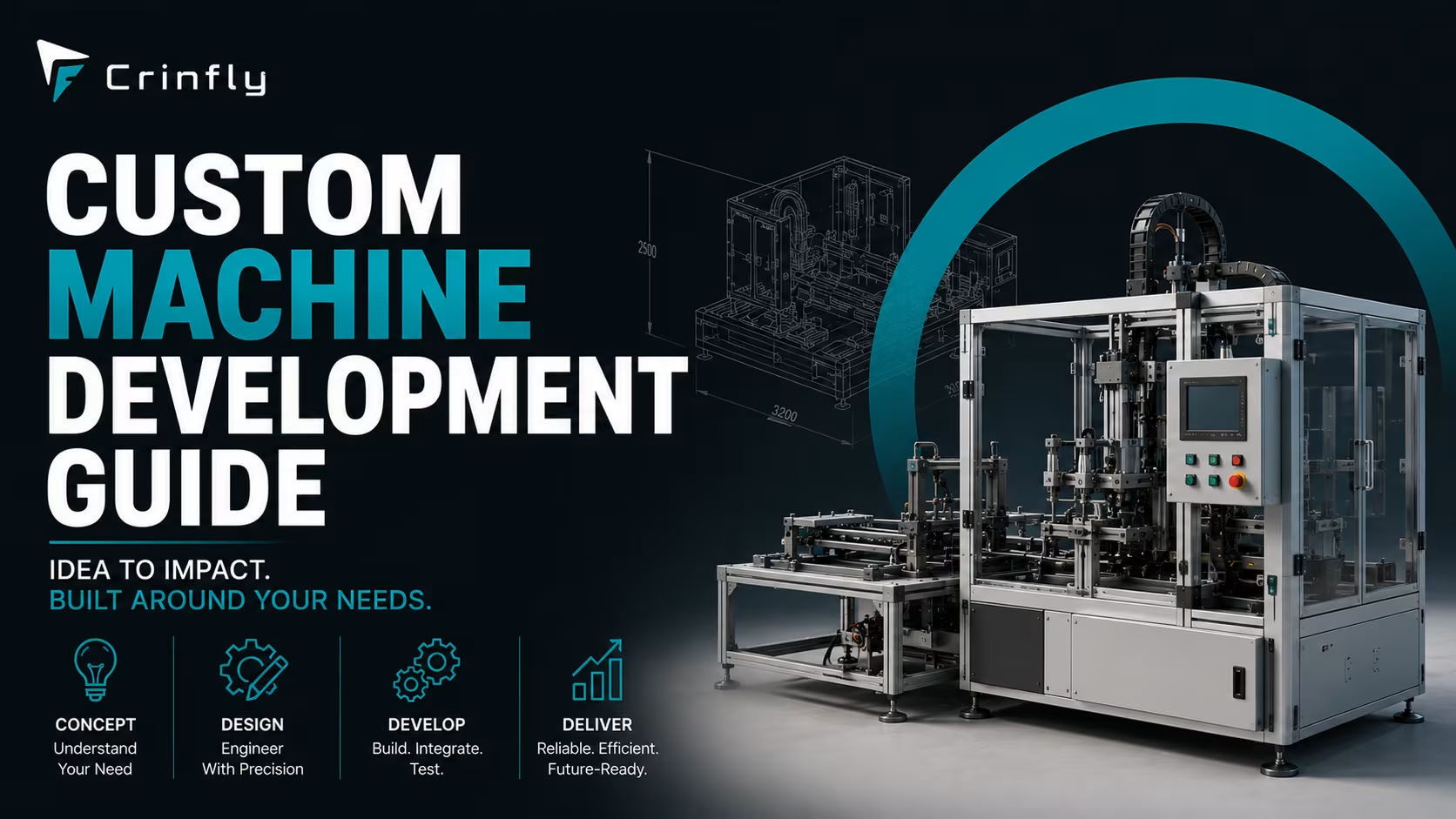
Custom machine development is the specialized engineering process of designing, fabricating, programming, and deploying unique industrial equipment built specifically to execute a proprietary manufacturing task that standard machinery cannot perform.
Quick Answer
To successfully develop a custom machine, you must freeze the product design first, execute digital physics simulations, strictly define the machine's cycle-time ROI, and mandate open communication protocols for factory integration.
Expert Tip
Never begin fabricating the physical frame of a custom machine until the software logic and PLC (Programmable Logic Controller) architecture have been fully mapped and virtually simulated. Software complexity is where 80% of custom projects derail.
Decision Rule
If modifying an existing off-the-shelf machine costs more than 60% of the price of developing a brand-new custom machine from scratch, the superior financial decision is to invest in custom development to retain full IP and perfect functionality.
Warning
Failing to demand a rigorous Factory Acceptance Test (FAT) utilizing your exact production-grade raw materials will result in a custom machine that works perfectly in the vendor's lab but jams constantly on your factory floor.
Best Practice
Always leverage your investment in proprietary machinery within your industrial branding. Proving to the market that you own exclusive, custom-built production technology is the ultimate differentiator for securing massive B2B contracts.
Table of Contents
- The Proprietary Advantage of Custom Machinery
- The B.U.I.L.D. Development Framework
- Comparison: Off-the-Shelf vs. Custom Development
- Step-by-Step Custom Machine Guide
- Current Trends in Custom Engineering
- 5 Common Machine Development Mistakes
- Key Facts at a Glance
- Frequently Asked Questions
The Proprietary Advantage of Custom Machinery
Quick Answer
Custom machinery grants manufacturers absolute control over their production speeds, quality tolerances, and operational data, providing a competitive moat that competitors cannot simply purchase from a catalog.
Why It Matters
If you use the exact same catalog machinery as your competitors, you can only compete on labor costs or raw material pricing. Custom machinery allows you to manufacture a superior product at a speed your competitors cannot replicate.
Expert Insight
As a senior industrial consultant, I see companies reject custom machines due to the initial CapEx. What they fail to calculate is the cost of compromise. Forcing a proprietary product through a generic machine results in high scrap rates, constant manual interventions, and an eventual erosion of product quality.
Detailed Explanation
Custom machine development requires bringing together mechanical engineering, electrical design, pneumatic routing, and complex software programming (IT/OT integration). These machines are built to solve hyper-specific bottlenecks, such as a specialized automated packaging system designed for an irregularly shaped consumer product that jams standard conveyors. Because the machine is built specifically for your ecosystem, there is zero wasted functionality.
Real Example
A specialized aerospace battery manufacturer could not find a robotic welding cell capable of handling their proprietary alloy without heat warping. A Crinfly engineering team developed a custom automated laser-welding machine with closed-loop thermal feedback sensors. This custom unit reduced battery rejection rates from 14% to 0.2%, paying for itself within 11 months.
Business Application
Own the IP of the custom machine design. If you develop a revolutionary manufacturing method, patent the machine's process. This adds massive tangible asset value to your corporate valuation.
Key Takeaway
Custom machinery is not just an operational tool; it is a highly defensible intellectual property asset.
The B.U.I.L.D. Development Framework
To eliminate the extreme risks of custom hardware development, the Crinfly Ecosystem employs the proprietary B.U.I.L.D. methodology.
- Blueprint: Establish absolute clarity on the machine's required output, cycle time, physical footprint, and safety compliance parameters before any CAD work begins.
- Unitize: Break the massive machine into smaller, manageable sub-assemblies (e.g., material feed unit, processing unit, outfeed unit). Engineer and simulate each unit independently.
- Integrate: Ensure the machine's digital brain (the PLC) is programmed with open protocols to seamlessly share cycle data with your factory's central ERP system.
- Launch (FAT/SAT): Execute brutal testing. First, at the assembly facility (Factory Acceptance Test), and secondly on your actual factory floor (Site Acceptance Test) under full production load.
- Deploy: Transition the machine into live production alongside rigorous operator training and the establishment of predictive maintenance schedules.
Comparison: Off-the-Shelf vs. Custom Development
| Decision Factor | Off-the-Shelf Machinery (COTS) | Custom Machine Development |
|---|---|---|
| Initial CapEx Cost | Lower; R&D costs are spread across many buyers | High; you bear the entire R&D burden |
| Lead Time | Fast; weeks to months | Slow; 6 to 18 months of engineering and fabrication |
| Competitive Advantage | Zero; competitors can buy the exact same unit | Absolute; proprietary technology locked inside your walls |
| Functionality Match | Approximate; often requires product redesign to fit | Perfect; machine is built precisely around the product |
| Data Integration | Vendor-dependent; sometimes locked in proprietary ecosystems | Customizable; guaranteed native integration with your ERP |
| Maintenance | Standardized manuals and global part availability | Requires detailed custom documentation and local support |
| Risk | Low integration risk | High initial engineering risk, mitigated by simulation |
| Best Use Case | Standardized processes (e.g., standard palletizing) | Proprietary assembly, unique materials, extreme tolerances |
Step-by-Step Custom Machine Guide
- Freeze the Product Design: Do not build a custom machine for a product that is still in prototyping. A one-millimeter change to the product can require rebuilding the entire machine.
- Draft the Functional Requirement Specification (FRS): Document exactly what the machine must do, how fast it must do it, and the safety standards it must pass (e.g., CE, UL, OSHA).
- Digital Twin Engineering: Build the complete machine in 3D CAD. Run kinematic simulations to ensure moving parts do not clash and cycle times mathematically meet the FRS.
- Control Systems Programming: Write the PLC code concurrently with the mechanical build. Ensure the Human-Machine Interface (HMI) is intuitive for your specific operators.
- Fabrication and Assembly: Machine the custom parts, weld the frame, wire the electrical panels, and route the pneumatics.
- The FAT (Factory Acceptance Test): Run the machine using your actual raw materials. Do not accept delivery until it hits the promised cycle time continuously for an extended run.
- Commissioning and SAT: Install the machine, connect it to your factory's utility drops, and run the final Site Acceptance Test to verify performance in the real-world environment.
Current Trends in Custom Engineering
Quick Answer
Custom machine builders are utilizing Modular Mechatronics, AI-driven machine vision for adaptive handling, and digital-first documentation.
Why It Matters
These trends drastically reduce the "infant mortality" phase of custom machines. By using modular, proven sub-components, engineers reduce the amount of totally unproven mechanics in the build, accelerating reliability.
Expert Insight
The era of the purely mechanical custom machine is over. Today, 70% of the value of a custom machine is in the software and sensors. We use AI vision systems that allow the machine to adapt to slight variations in the raw material, rather than jamming when a piece of plastic is slightly out of tolerance.
Detailed Explanation
Modular Mechatronics means that instead of designing a custom conveyor belt from scratch, the engineer uses a proven, off-the-shelf smart conveyor module and only customizes the end-of-arm tooling that interacts with the product. Furthermore, custom machines are now delivered with digital-first documentation. Instead of a massive paper binder, operators use AR (Augmented Reality) tablets that overlay maintenance instructions directly onto the physical machine.
Real Example
A custom machine designed to assemble delicate medical syringes utilized an AI vision system rather than rigid mechanical guides. If a syringe barrel entered the machine slightly rotated, the AI calculated the offset in milliseconds and rotated the robotic gripper to match, completely eliminating shattered glass on the line.
Business Application
Use the data generated by your smart custom machine to prove your quality control standards to B2B clients. Offering a "zero-defect" guarantee wins major contracts.
Key Takeaway
Modern custom machines must be adaptable. Use software and sensors to build a machine that handles real-world variations gracefully.
5 Common Machine Development Mistakes
- Mistake 1: Moving Targets (Scope Creep). Why it happens: Changing the product design after machine fabrication begins. Impact: Massive engineering rework costs and multi-month delays. How to avoid it: Institute a hard "Design Freeze" before signing the machine contract.
- Mistake 2: Over-Customizing Everything. Why it happens: Engineers treating the project like a science experiment. Impact: The machine is impossible to repair because even the screws are custom-made. How to avoid it: Mandate the use of Standard Off-The-Shelf (COTS) components for all non-proprietary functions (motors, bearings, sensors).
- Mistake 3: Skipping the FAT. Why it happens: Pressure to get the machine on the floor quickly. Impact: Discovering fatal design flaws in your factory, halting production while engineers try to rewrite code on the fly. How to avoid it: The Factory Acceptance Test is legally non-negotiable.
- Mistake 4: Ignoring the Operator UI. Why it happens: Software engineers design the screen for other software engineers. Impact: Machine operators cannot figure out how to clear a simple jam, causing hours of unnecessary downtime. How to avoid it: Design the HMI (Human-Machine Interface) with highly visual, color-coded troubleshooting guides.
- Mistake 5: Failing to Secure the IP. Why it happens: Not reading the fine print of the engineering contract. Impact: The engineering firm retains the rights to the machine design and sells the exact same competitive advantage to your rival. How to avoid it: Clearly establish IP ownership of the final machine design in the initial contract.
Key Facts at a Glance
- Definition: Custom machine development is the end-to-end engineering of proprietary hardware designed to execute a specialized manufacturing task.
- Best Practices: Rely heavily on 3D physics simulations to debug the machine's mechanics digitally before purchasing a single piece of physical steel.
- Decision Criteria: Invest in custom machinery when standard equipment forces you to compromise the quality, speed, or proprietary nature of your product.
- Checklist: Freeze product design, draft the FRS, run digital twins, mandate COTS components where possible, establish IP rights, and execute the FAT.
- Summary: While capital-intensive, custom machine development provides manufacturers with an insurmountable competitive moat, fusing proprietary processes with high-speed, data-driven automation.
Frequently Asked Questions
How much does it cost to develop a custom manufacturing machine?
Costs vary astronomically based on complexity, but a general baseline is that custom development will cost 2x to 4x more than an off-the-shelf machine of similar size. You are paying for the initial engineering R&D, the programming, and the risk mitigation. A simple custom sorting conveyor might cost $100,000, while a fully automated, multi-axis robotic assembly cell can easily exceed $2 million.
How long does the custom machine development process take?
From the initial concept meeting to final installation on your factory floor, a custom machine project typically requires 9 to 18 months. This timeline accounts for structural engineering, ordering long-lead-time servo motors, writing thousands of lines of PLC code, and conducting rigorous FAT/SAT testing to ensure absolute reliability.
Why is a Design Freeze so critical before starting?
A custom machine is a physical manifestation of your product's exact dimensions. If you approve the machine design, and then decide your product needs to be 5mm wider, the custom grippers, tracks, and sensors on the machine will no longer fit. This causes a cascade of engineering rework that obliterates budgets and timelines. Lock the product first.
What is a Functional Requirement Specification (FRS)?
The FRS is the master contract document for the machine build. It dictates exactly what the machine will do without dictating exactly how it does it. It includes required cycle times (e.g., 60 parts per minute), acceptable defect rates, power consumption limits, and safety standards. If the final machine meets the FRS, the engineering project is deemed successful.
Who owns the Intellectual Property (IP) of a custom machine?
IP ownership must be negotiated before the contract is signed. Typically, if you pay for the full R&D and engineering time, you can demand full IP ownership, preventing the firm from building the same machine for a competitor. If the engineering firm subsidizes the R&D cost, they may retain the IP and grant you an exclusive or non-exclusive license to use it.
What happens if the custom machine breaks down?
Because it is a one-of-a-kind machine, you cannot simply look up a YouTube tutorial. To mitigate this risk, you must demand that the machine is built using Commercial Off-The-Shelf (COTS) parts for all common components (like pneumatics and motors). This ensures your local maintenance team can source replacement parts quickly. Furthermore, mandate comprehensive digital schematics and troubleshooting manuals upon delivery.
Can we integrate a custom machine into our existing automated line?
Yes, and this is a core requirement of the B.U.I.L.D. framework. The custom machine's PLC must be programmed to communicate with upstream and downstream equipment. If an upstream generic filler stops, the custom machine must instantly know to pause its operations to prevent a dry-run error. This requires establishing strict IT/OT network protocols early in the design phase.
Why do custom machines rely so heavily on sensors?
Custom machines often handle novel, untested physical processes. They lack the decades of iterative refinement that standard machines possess. To prevent catastrophic jams, engineers pack custom machines with proximity, thermal, and optical sensors. If a part shifts slightly out of alignment, the sensors detect it in milliseconds and halt the machine before physical damage occurs.
What is the difference between a FAT and a SAT?
A Factory Acceptance Test (FAT) happens at the machine builder's facility; you verify it works in a controlled environment. A Site Acceptance Test (SAT) happens on your factory floor after it is installed. The SAT proves the machine functions perfectly when connected to your specific electrical grid, your compressed air supply, and integrated with your human operators.
Is CE or UL certification required for custom machinery?
Yes. Regardless of whether the machine is one-of-a-kind, it must meet the strict electrical and mechanical safety regulations of the region where it will operate (CE in Europe, UL/OSHA in the United States). The engineering firm must design safety interlocks, light curtains, and emergency stops (E-stops) to guarantee the machine is legally compliant and safe for human operators.
How do we train our staff to run a machine that has never existed before?
Training must begin during the FAT phase. Send your lead machine operators and maintenance staff to the builder's facility to learn the machine intimately before it ships. Additionally, demand that the Human-Machine Interface (HMI) is programmed with intuitive, visual prompts, and require the vendor to provide on-site training during the first two weeks of live production.
When does a custom machine become a bad investment?
Custom development is a bad investment if you are building it simply because you refuse to slightly alter your product design to fit a standard machine. If altering an internal, non-visible plastic clip allows you to use a standard $50,000 automated packaging machine instead of developing a $400,000 custom machine, redesign the product immediately.
Conclusion
Custom machine development is the pinnacle of industrial engineering. It is the bold decision to stop compromising with off-the-shelf limitations and build exact, proprietary hardware that guarantees market dominance. By utilizing rigorous standards like the B.U.I.L.D. framework, mandating absolute digital simulation, and enforcing strict FAT protocols, manufacturers eliminate the chaotic risks of custom hardware. Ultimately, a successfully deployed custom machine within the Crinfly Ecosystem ceases to be an expense; it transforms into an impenetrable intellectual property asset that accelerates unprecedented business growth.
Call to Action
Do not let standard machinery dictate the limits of your innovation. Partner with the Crinfly Ecosystem today to engineer and deploy your proprietary manufacturing hardware. Let our specialized teams build the custom automation your factory needs to scale beyond the competition.